Knowledge-loss risk
Knowledge-loss risk, mapped
Mimorian shows who holds the experience for each machine, and where your plant is exposed at the next departure. Knowledge-loss risk stops being a vague worry and becomes a map you can act on.
Mimorian's knowledge-loss risk is a map, machine by machine and field by field, of who holds the experience and where the plant has only one expert left. It is built from CMMS history, by cross-referencing each technician's interventions with the criticality of the equipment.
The core problem: undocumented critical know-how is an unprovisioned risk
CMMS systems have stored who worked on what for years. But no one has ever cross-referenced that data with equipment criticality and departure profiles.
As a result, the site director cannot see the weak points before they turn into a breakdown or a departure. The continuity of a line can depend on two people without anyone ever having stated it.
Mapping knowledge-loss risk means making that dependency visible, field by field, so you can decide ahead of the loss rather than suffer it.
What Mimorian makes visible
From the concentration of know-how to the register of technicians, Mimorian turns CMMS history into a clear reading of your exposure.
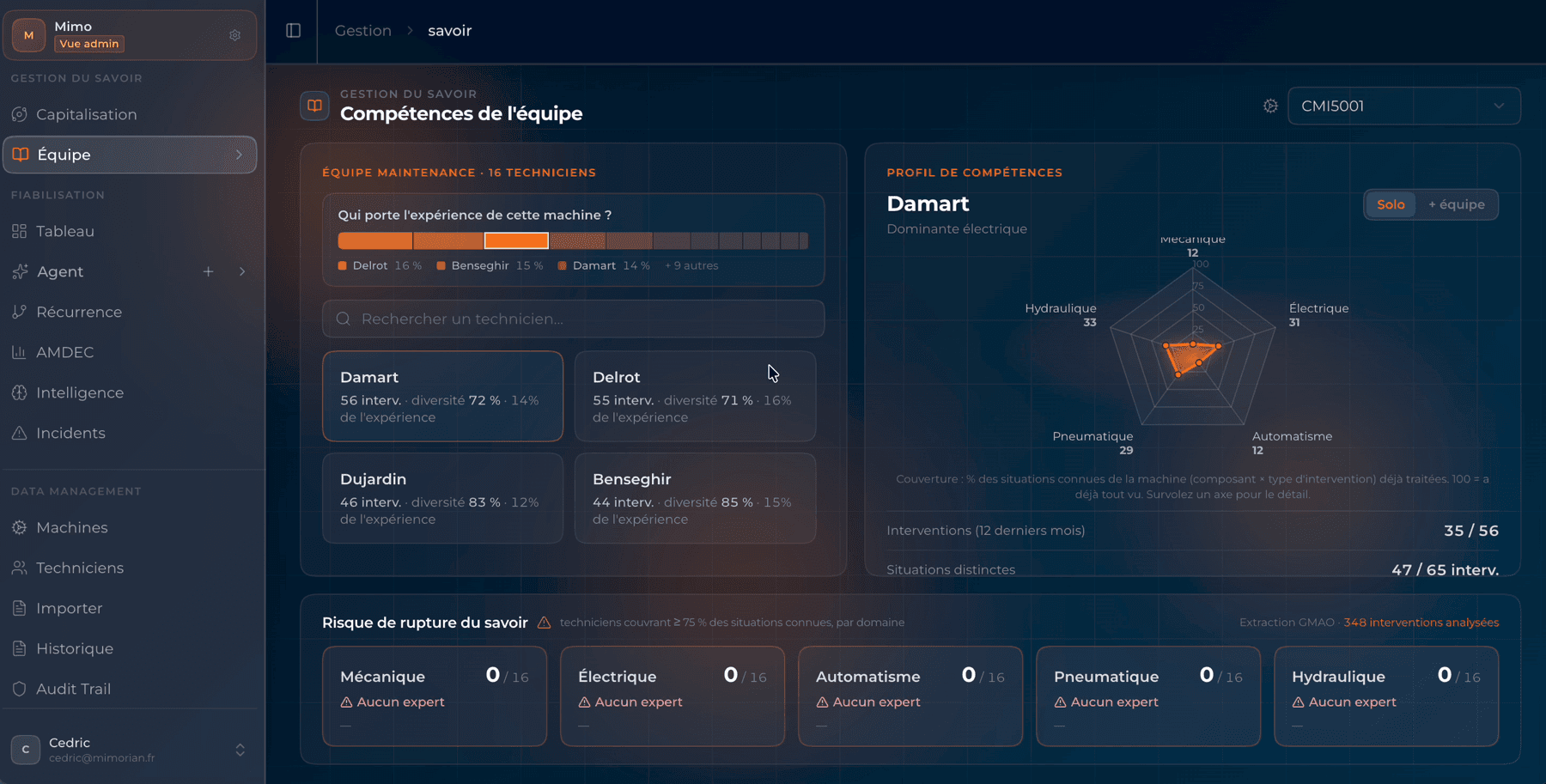
“Who holds the experience for this machine?”
The concentration of know-how, in plain terms: the share of experience held by each technician on a given machine. When a single person holds most of it, it shows.
A skills profile for each technician
A radar across the five fields of maintenance (mechanical, electrical, automation, pneumatic, hydraulic), with coverage of known situations, the breadth of experience and the dominant specialty.
Knowledge-loss risk by field
The number of technicians covering at least 75% of known situations, on four levels: no expert, single expert, fragile redundancy, covered. An immediate reading of exposure to a departure.
A register of technicians
A clean identity record for each person: status, source, linked accounts, aliases, interventions and last intervention. The basis for a reliable attribution of know-how.
Deduplication of contributors
Mimorian turns raw CMMS names into clean records and merges duplicates, with an audit trail. The map then rests on real people, not on spelling variants.
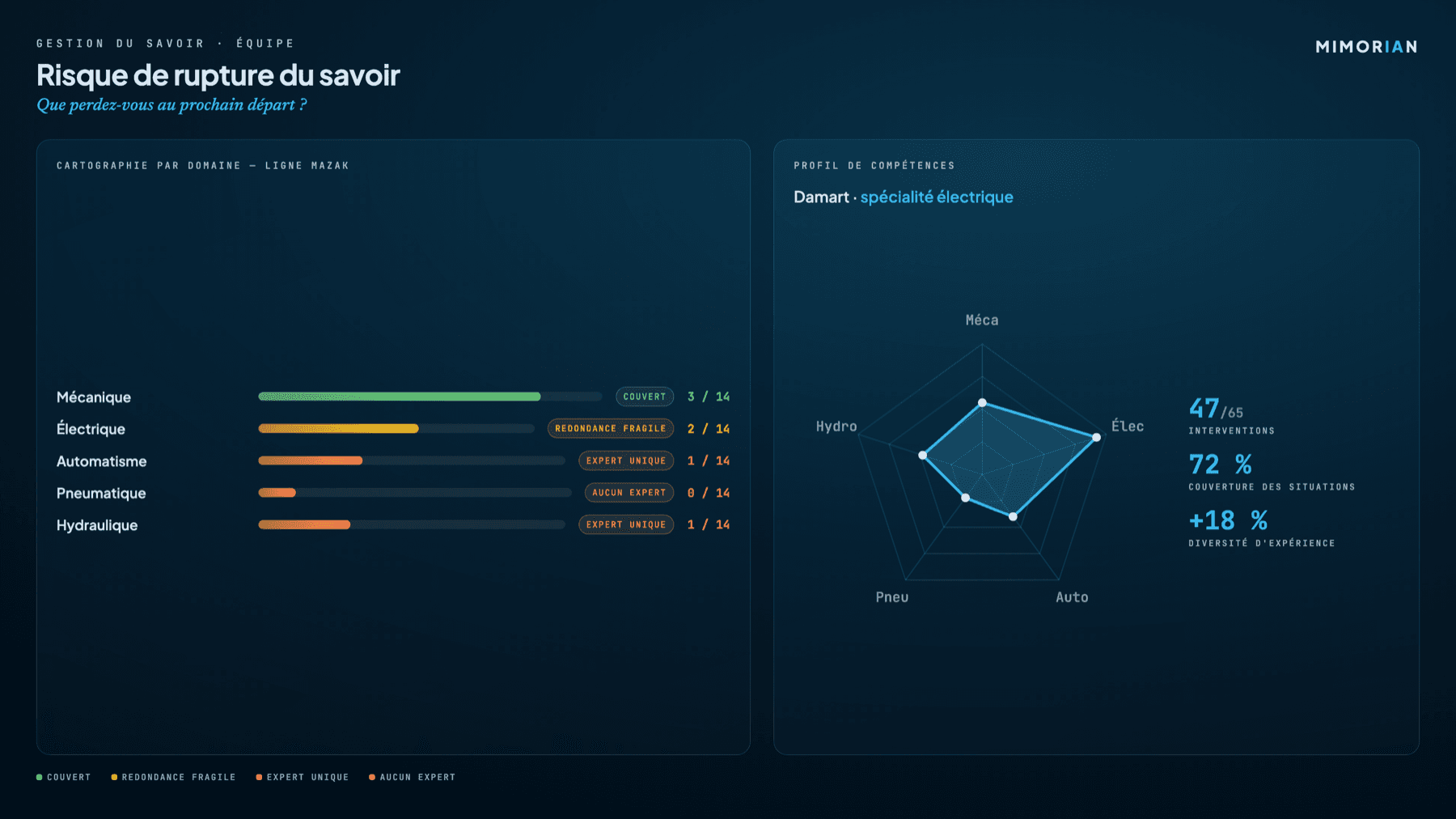
Undocumented critical know-how is an unprovisioned risk. Mimorian makes it visible before it turns into a breakdown or a departure.
How Mimorian maps the risk
From CMMS history to a reading of risk by field, in three steps.
Mimorian imports the CMMS history
With the identifier of the technician involved: who worked on which piece of equipment, on which type of situation.
It deduplicates and cross-references
Contributors are merged into clean records, then their interventions are cross-referenced with the criticality of the machines.
It displays the exposure
Concentration of know-how, skills profiles and knowledge-loss risk by field become legible, on your own data.
Who the risk map serves
Site management
It sees, on its own data, that the continuity of a line depends on two people, and anticipates critical departures.
Maintenance manager
He focuses training plans on the real skill gaps, not on a generic grid.
Finance management
It turns an invisible risk into a map it can act on, useful in a sale or a due diligence audit.
Fits into your existing stack
The risk map, as a ready-to-use SaaS, starts from your existing CMMS history and reads what your teams have already logged.
Knowledge-loss risk, fed by capture and mapping
Every piece of know-how captured by maintenance know-how capture and every component of the functional mapping sharpens the reading of risk. The more the plant documents, the clearer its exposure becomes.
Frequently asked questions about knowledge-loss risk
How does Mimorian know who holds a machine's know-how?
From the CMMS history: who worked on which piece of equipment, on which type of situation. Mimorian deduplicates the contributors, cross-references their interventions with the criticality of the machines, and derives the concentration of experience, technician by technician.
What is “knowledge-loss risk”?
It is the bus factor of your maintenance, by field: how many technicians cover at least 75% of known situations on a machine family. Mimorian classifies it on four levels, from “No expert” to “Covered”, to show where the plant is exposed to a departure.
Do you have to enter the skills by hand?
No. The skills are derived from the actual interventions recorded, not from a declarative grid kept on the side. The map reflects what the technicians actually did, not what was written about them.
What is the deduplication of technicians for?
Names coming from the CMMS are often raw and duplicated (spelling variants, aliases, multiple accounts). Mimorian merges them into clean identity records, with an audit trail. This is the condition for a reliable attribution of know-how and an accurate map.
Other Mimorian features
Functional mapping
Functional machine mapping
Your electrical, pneumatic and hydraulic diagrams become a navigable knowledge graph. The machine becomes legible, not just documented.
ExploreKnowledge capture
Maintenance know-how capture
Every intervention enriches the plant's memory. Know-how stops leaving with the people who hold it.
ExploreGuided diagnostics
AI-guided diagnostics
From symptom to root cause. Targeted hypotheses, verifiable tests, and reasoning visible at every step.
ExploreRecurrence
Recurrence analysis and reliability
The failures that keep coming back, ranked by occurrence and grouped by cause. A reliability agent targets the actions that cut downtime.
ExploreSee knowledge-loss risk across your fleet
Give us a CMMS export. We will show you who holds the experience for your machines and where you are exposed, in 30 minutes.