Guided diagnostics
AI-guided diagnostics, from symptom to root cause
Mimorian traces the cause. Several specialised agents cross-reference the machine mapping, the documentation and the history to propose targeted hypotheses, verifiable tests and reasoning visible at every step.
Mimorian's guided diagnostics is AI-assisted reasoning that leads the technician from symptom to root cause: several specialised agents cross-reference the machine mapping, the documentation and the history to propose targeted hypotheses and the tests that validate them.
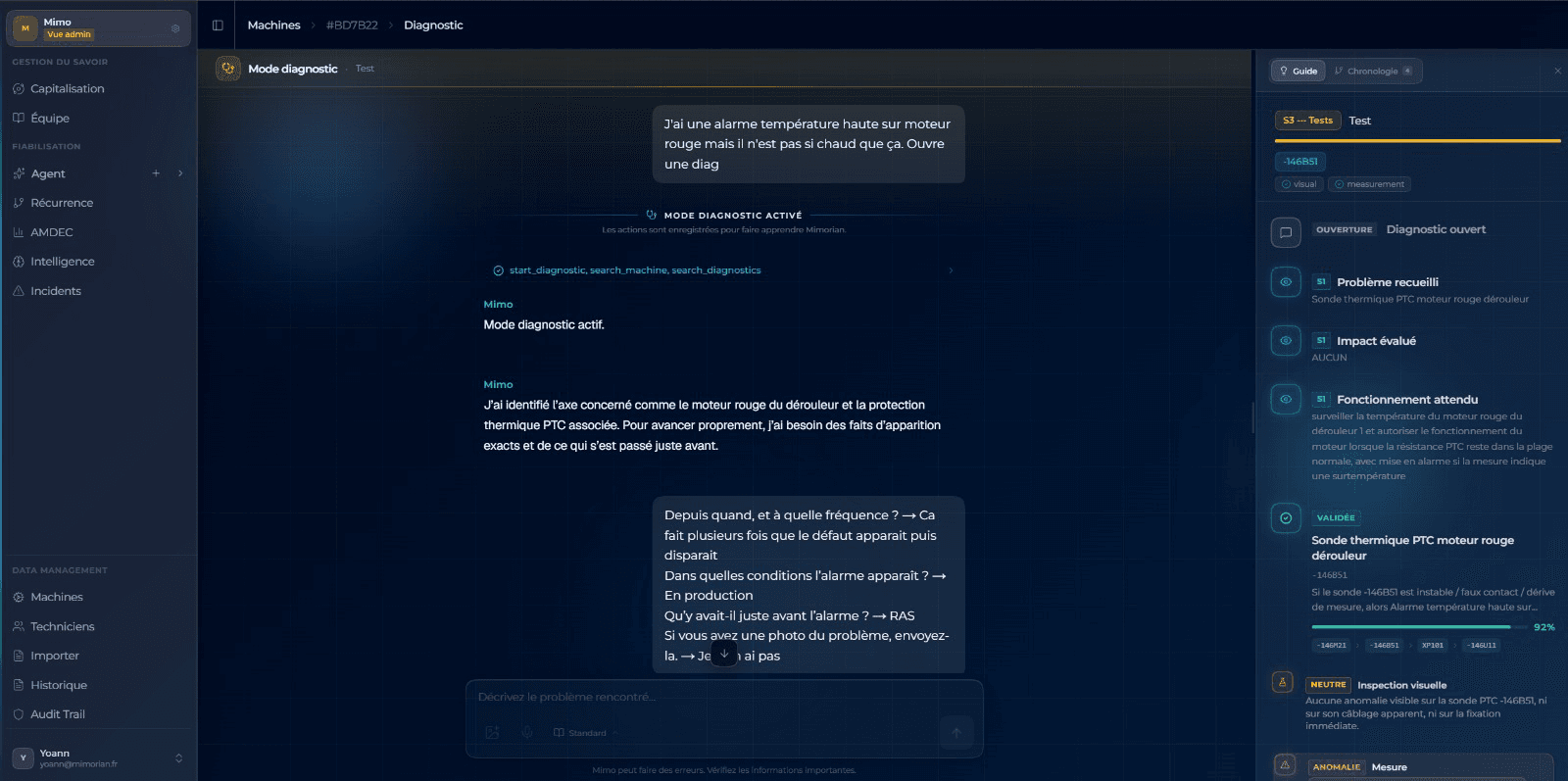
The core problem: facing a complex failure, the reasoning rests on the technician alone
For standard, documented failures, the procedure is enough. For complex or unprecedented failures, the ones that weigh most heavily during downtime, the symptom to cause to remedy reasoning stays entirely on the technician.
The CMMS can display the history of previous interventions, but it offers neither ranked hypotheses nor the most discriminating tests. Without a method, the symptom gets treated rather than the cause: the fuse blows again three weeks later.
Guided diagnostics brings that method: structuring the reasoning, proposing targeted leads and tracing back to the root cause.
What Mimorian's guided diagnostics does
A multi-agent architecture that reasons on the real machine, proposes, and always leaves the decision to the technician.
A multi-agent architecture
Several specialised agents coordinate: one agent draws on the documentation, one agent analyses past interventions, one agent checks physical consistency. An orchestrator aggregates their outputs.
Targeted hypotheses based on context
Mimorian proposes ranked hypotheses and guides toward the tests that validate or rule out each one. The number depends on the failure, not on a fixed format.
Reasoning that traces back to the root cause
Mimorian does not stop at suggesting a part replacement. It helps distinguish the replaced component from the real cause, so you treat the underlying problem, not just the symptom.
The technician stays in control
He can rule out a lead by explaining why, and that feedback refines the reasoning. The AI proposes, the technician decides, at every step.
A voice interaction
The technician describes the situation in his own words, hands busy with the intervention, with no keyboard entry.
A structured report as output
The cause, the tests carried out and the return to normal are structured and sent back to the CMMS. The diagnosis enriches the history instead of shrinking to a single line.
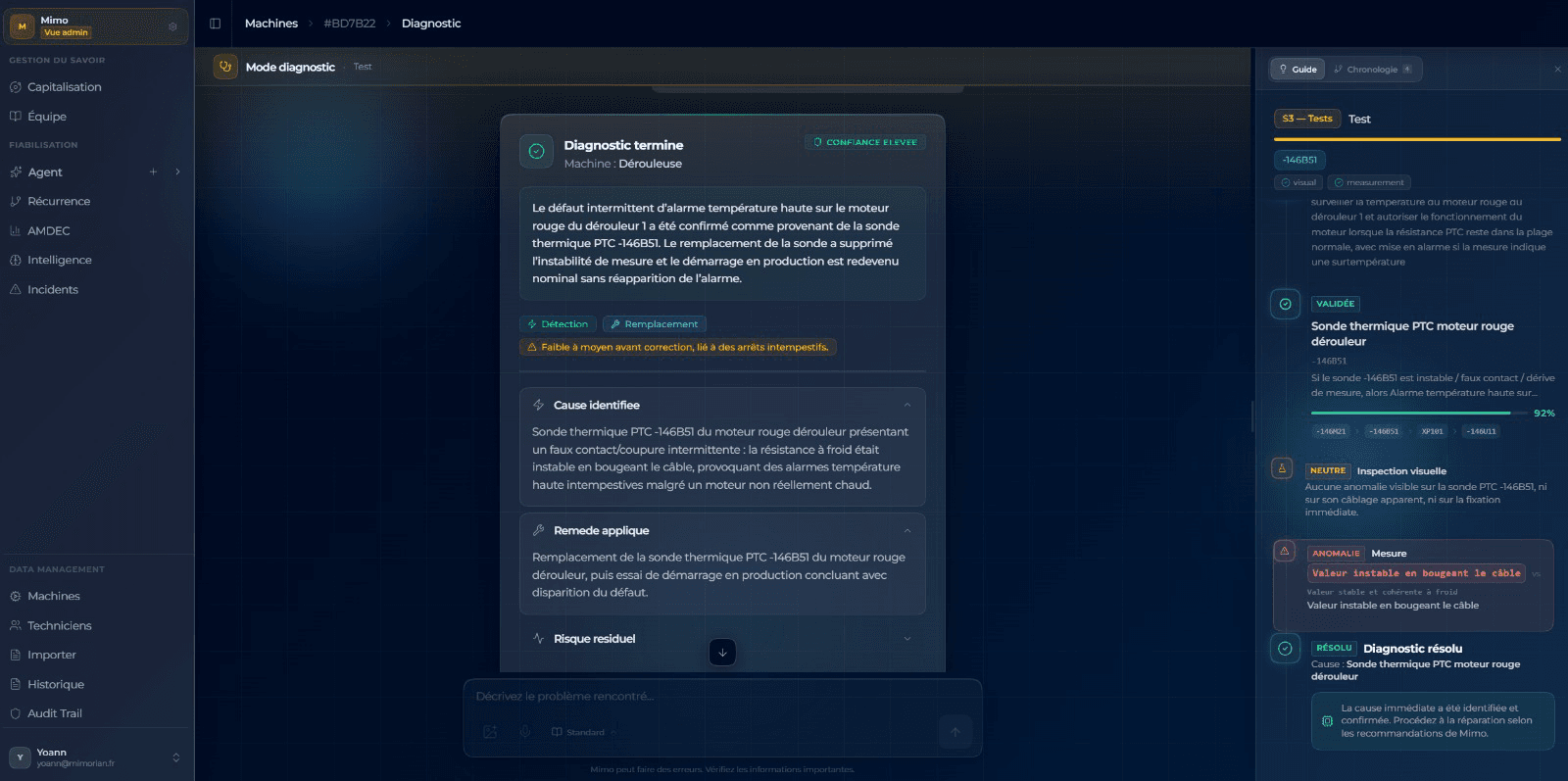
A recommendation you cannot verify has no value in maintenance. Mimorian shows its reasoning, cites its sources and leaves the decision to the technician: trustworthy AI, not autonomous AI.
How Mimorian runs a diagnosis
From a symptom described by voice to a captured report, in four steps.
The technician describes the symptom
By voice, in his own words. Mimorian opens a diagnostics session.
The agents cross-reference the sources
The machine mapping, the documentation and the intervention history are analysed in parallel.
Mimorian proposes and tests
Targeted hypotheses and the first discriminating test, to move methodically toward the cause.
The cause confirmed, the know-how stays
The structured report enriches the plant's memory and goes back to the CMMS.
General-purpose AI assistant or guided diagnostics: what is the difference?
A general-purpose assistant answers anything, knowing nothing about your machine. Guided diagnostics reasons on your real equipment.
Who guided diagnostics serves
Junior technician
He resolves in minutes a failure that would have called for an expert, by following the reasoning laid out step by step.
Expert technician
He is no longer called for the recurring failure. His level is reserved for the real cases.
Production director
MTTR drops on complex failures, and reliance on a handful of experts decreases.
Fits into your existing stack
Guided diagnostics comes to the technician's workstation, alongside your tools, as a ready-to-use SaaS. It sends a structured report back to the CMMS at the end of the intervention.
Diagnostics, wired into mapping and knowledge capture
The diagnosis reasons on the machine's functional mapping, and each resolution feeds the maintenance know-how capture. A legible machine, guided diagnostics, know-how that accumulates: the same virtuous circle.
Frequently asked questions about guided diagnostics
How does guided diagnostics differ from a general-purpose AI assistant?
A general-purpose assistant answers from the web, without knowing your machine. Mimorian's guided diagnostics starts from the functional mapping of your equipment, your diagrams and your intervention history. It proposes targeted hypotheses and the tests that validate them, with traceable reasoning.
Does the technician keep the decision?
Yes. The AI proposes, the technician decides. He can rule out a lead by explaining why, and that feedback refines Mimorian's reasoning. Every suggestion is traceable and sourced, in line with the human oversight principle of the AI Act.
Do you have to type on a keyboard mid-intervention?
No. The technician describes the symptom by voice, in his own words, hands busy with the intervention. Mimorian runs the diagnosis from that description.
What becomes of the diagnosis once the failure is resolved?
The immediate cause, the tests carried out and the return to normal are structured into a report, sent back to the CMMS and captured in the plant's memory. Today's diagnosis speeds up tomorrow's.
Other Mimorian features
Functional mapping
Functional machine mapping
Your electrical, pneumatic and hydraulic diagrams become a navigable knowledge graph. The machine becomes legible, not just documented.
ExploreKnowledge capture
Maintenance know-how capture
Every intervention enriches the plant's memory. Know-how stops leaving with the people who hold it.
ExploreRecurrence
Recurrence analysis and reliability
The failures that keep coming back, ranked by occurrence and grouped by cause. A reliability agent targets the actions that cut downtime.
ExploreKnowledge-loss risk
Knowledge-loss risk
Who holds the experience for each machine, and where your plant is exposed at the next departure.
ExploreSee guided diagnostics on one of your failures
Describe a failure that cost you dearly. We will show you how Mimorian diagnoses it, step by step, in 30 minutes.