Recurrence
Recurrence analysis, turning the failures that keep coming back into reliability actions
On the input side, everything that caused stoppages on the machine. On the output side, targeted actions to cut that downtime. Mimorian ranks recurring failures, groups them by cause, and opens a reliability agent on demand.
Mimorian's recurrence analysis reads a machine's interventions and incidents to surface the failures that keep coming back, rank them by occurrence and group them into clusters. On a component, a reliability agent analyses the remedies already applied and their convergences to target the actions that cut downtime.
The core problem: the same failure comes back, never treated at the root
On a machine, a few failures account for the largest share of downtime. They come back, they get repaired, they come back again. The pattern is in the data, but no one sees it.
The CMMS records every intervention, line after line. It keeps the trace of the action, not the overall picture. The fuse that blows every three weeks gets replaced every three weeks, while the underlying cause never surfaces.
Reliability work needs to see that pattern to act on it. Recurrence analysis brings that history back to life instead of leaving it dormant in the CMMS: it makes the pattern visible and usable, which failures weigh most, on which components, and which actions reduce them.
What Mimorian's recurrence analysis does
Mimorian reads the machine's history, surfaces the failures that weigh most, and opens reliability reasoning on demand.
A Pareto of occurrences
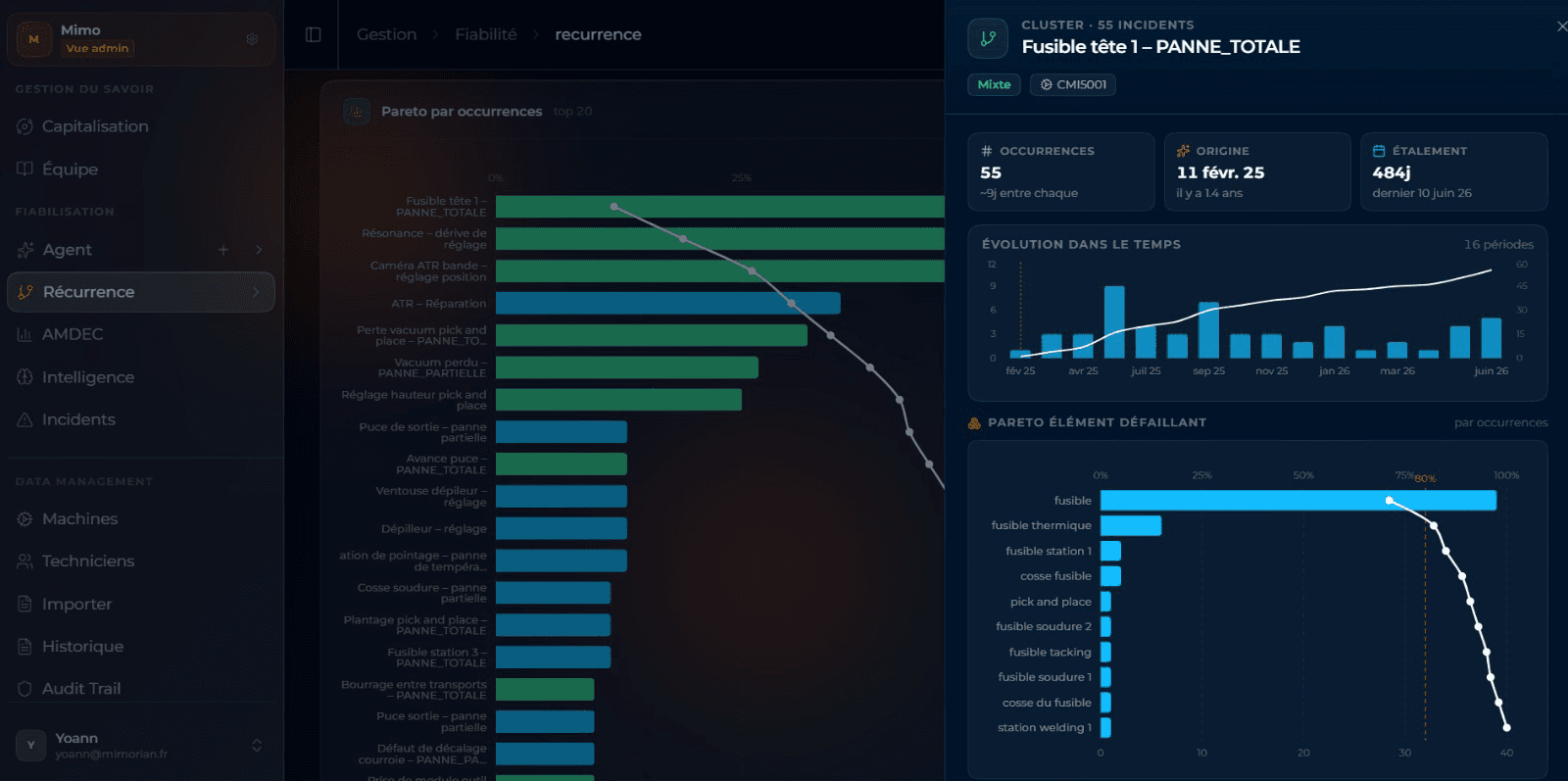
Failures are ranked by their weight on uptime. At a glance, you see the few recurrences that cost the most downtime, rather than a flat list to sift through.
Failure clusters
Mimorian groups the incidents that converge on the same problem, for example a head fuse in total failure. The grouping rests on the real similarities, symptom, functional chain, components, with no field or label to configure up front. Each cluster carries its occurrence count, its origin and its spread over time.
Evolution over time
Each recurrence is tracked period by period: frequency, last occurrence, trend. You can see whether a problem is getting worse, holding steady or receding after an action.
A Pareto of the failing element
The analysis drills down to the component that comes back most often in a cluster's incidents, so the action can be aimed at the right place.
A reliability agent on demand
Selecting a component opens the agent. It analyses the remedies already applied and their convergences, then proposes concrete actions to reduce or remove the downtime tied to that component.
A loop that closes
Reliability actions attach to the machine and its failures. The next recurrence reading shows their effect, and the know-how stays in the plant.
The analysis starts from the intervention and incident history already captured. The existing history is enough: the material comes directly from the maintenance work itself.
How Mimorian targets a reliability action
From raw history to a concrete action on the right component, in four steps.
Mimorian aggregates the history
The machine's interventions and incidents are gathered and made comparable.
It ranks the recurrences
A Pareto of occurrences, failure clusters and evolution over time surface what weighs most.
You open the agent on a component
A click on the component opens the reliability agent, with the full context of its past failures.
The agent proposes targeted actions
It analyses the applied remedies and their convergences, then proposes actions to reduce the downtime tied to that component.
CMMS history or recurrence analysis: what is the difference?
The CMMS keeps the trace of every intervention, but the data stays dormant. Recurrence analysis draws out the pattern and the action.
Who recurrence analysis serves
Reliability engineer, methods
He builds his improvement plans on quantified recurrences rather than impressions, and measures the effect of his actions period after period.
Maintenance manager
He knows which failures weigh most on uptime and where to concentrate the effort to cut downtime.
Production director
He sees recurring downtime recede, because maintenance treats the underlying causes and no longer just the symptoms.
Fits into your existing stack
Recurrence analysis works on the history you already have, from a simple export and alongside your tools. It returns a usable reading and targeted actions.
Recurrence, fed by knowledge capture and diagnostics
Every captured piece of know-how and every guided diagnosis feeds the recurrence analysis. The more failures the plant resolves with Mimorian, the richer the reliability reading: the same virtuous circle. To see it on a real case, read the recurring-failure use case on a heat-treatment furnace.
Frequently asked questions about recurrence analysis
Do you need sensors to analyse failure recurrence?
No, neither sensors nor an IoT project. The material already exists: the intervention and incident history, often left dormant in the CMMS. Mimorian brings it back to life and surfaces the failures that keep coming back. The data comes from the maintenance work itself.
What is a failure cluster in Mimorian?
It is a grouping of incidents that converge on the same problem, for example the same failure on a head fuse. The cluster carries its occurrence count, its origin, its spread over time and the most frequent failing element.
What is the reliability agent?
It is an agent you open on a component. It analyses the remedies already applied to its failures and their convergences, then proposes concrete actions to reduce or remove the downtime tied to that component. You keep the decision on which actions to carry out.
How is this different from my CMMS history?
A CMMS can surface recurrences, but only if strict rules are set up front: defined fields and a word list that the technician must select rigorously on every report. The recurrence then depends on that manual tagging. Mimorian, by contrast, needs no setup: the technician describes the intervention in natural language, and Mimorian analyses the similarities, symptom, functional chain, components and any other contextual cues, to surface precisely the failures that repeat. The technician speaks, Mimorian restructures the data and files it in the right place.
Other Mimorian features
Functional mapping
Functional machine mapping
Your electrical, pneumatic and hydraulic diagrams become a navigable knowledge graph. The machine becomes legible, not just documented.
ExploreKnowledge capture
Maintenance know-how capture
Every intervention enriches the plant's memory. Know-how stops leaving with the people who hold it.
ExploreGuided diagnostics
AI-guided diagnostics
From symptom to root cause. Targeted hypotheses, verifiable tests, and reasoning visible at every step.
ExploreKnowledge-loss risk
Knowledge-loss risk
Who holds the experience for each machine, and where your plant is exposed at the next departure.
ExploreSee recurrence analysis on one of your machines
Show us a piece of equipment that fails often and a few months of history. We will show you the recurrences that weigh most and the reliability actions, in 30 minutes.